Posted by Simon on August 6, 2009

Spent Monday sifting through some wines for my regular Square Meal Lifestyle column. The next issue, looking at Australian Riesling, Cabernet Franc, Grüner Veltliner, Oloroso and southern Rhône reds, is out some time in Autumn. I already had the Rieslings lined up, but I needed to do some tasting in order to find candidates for the other slots. Here’s what I tried…
Posted by Simon on June 24, 2009

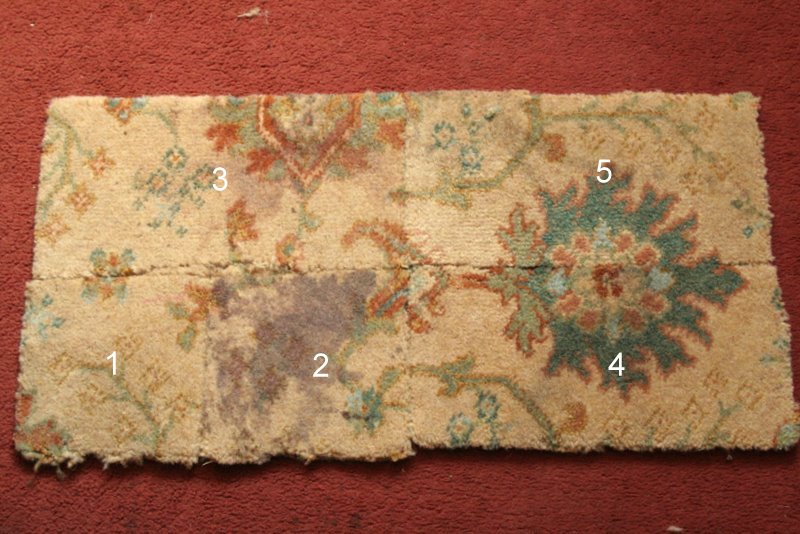
Some people have been in touch since I transferred the blog to the new site saying that while they liked the content, there weren’t enough pictures. So here’s a picture to keep them happy. Yes, I know, it’s a picture of a piece of carpet, what’s that got to do with wine? Look closer and you’ll see that it’s a piece of carpet that’s been chopped into five bits. Why? Step forward Wine Away, a specially developed stain remover made from fruit and vegetable extracts and billed by the manufacturers as ‘the only red wine stain remover recommended by the Good Housekeeping Institute.’
What about the Woods Housekeeping Institute? I thought I’d give it a whirl. We’ll get to the carpet in a mo, but first t-shirts. There comes a time in a man’s life when he realises that the snide comments that his wife has been giving him about all his white t-shirts-cum-vests having orange armpits is actually true. Cue trip to the supermarket for six new ones and also cue daddy and daughter heading into the garden to pour red wine all over six old ones – six, because I was going to try six different methods of getting the stains out. How did they fare?
Method 1) Just stick it in the wash
Not the best but surprisingly not the worst method – get it in there quickly and most of the damage will be undone.
Method 2) Run it under a cold tap, then wash
Worst of the lot. If there’s nothing else to hand, you’re better off just sticking your clothes in the washer.
Method 3) Sprinkle with lots of salt, then wash
Don’t bother. It’s better than using cold water, but not as good as just a simple wash.
Method 4) Pour white wine on, then wash
Not bad, an improvement on just washing, but there are better ways.
Method 5) Vanish Stain Remover, then wash
Pretty good, and from past experience a second application works even better.
Method 6) Wine Away, then wash
The winner by a slender margin – both this and the Vanish did a good job. It’s a bit alarming to see the stain go blue once you’ve sprayed the clothes, but this is apparently normal. Again, I’m sure a second dose would have been of benefit.
So Wine Away won the t-shirt test – now lets get onto the carpet…

Which bits were which?
Piece 1) A regime of regular soaking with cold water and blotting with a clean towel
This one was a tip from my father in law Howard, who used to have a flooring business. As you’ll see, it’s worked very well.
Piece 2) Sprinkled with lots of salt, with the remains then hoovered up
Once again, don’t bother. It does soak up some of the wine, but you’re better off just dabbing the stain with a cloth.
Piece 3) Pour white wine on
Better than the salt, but not by much – it seemed to make the stain lighter but spread it over a wider area. Save your white wine for drinking.
Piece 4) Vanish
Pretty good, and just from one application.
Piece 5) Wine Away
Came up a little lighter than the Vanish-ed piece, again with just one set of squirts.
As with the t-shirts a good performance by Wine Away. Piece 1), the one that was hosed down liberally with water, perhaps came up best, but such action does leave you with a mini-swamp on the floor.
So in conclusion, Vanish put up a good fight but the winner was Wine Away – it’s available for £8.99 per canister from www.wineawaydirect.co.uk and from a range of stores around the country.
Posted by Simon on June 21, 2009
It’s 2 in the morning and I’m still up. Why? Partly because I’ve had a great and stimulating day. It began with a talk from a Kiwi called Bob Franklyn that touched on many things, but that gave major prods about what it means to be community. Now whether we like it or not, we’re all part of some community or other – geographical, work-related, hobby-related etc.
Then this evening, I’ve been talking with my sister Stella who lives in Melbourne, but is over to see what the Aussies call The Olds – and of course to be pressed into babysitting duty by my immediate clan. Stella’s one of my favourite stimulators. At our worst, we bicker about irrelevancies, and at our best, we push each other onwards and upwards. And for someone like that, I want to pull out, not the trophy wines, but wines that move us (OK, a repetition) onwards and upwards.
She’s gone to bed now, as has Jill, leaving me alone with a BBC4 concert of Leonard Cohen and the remains of our last stimulating bottle. It’s from Corsica, the Domaine Saparale 2006 Corse Sartene. It’s a wine that started off shy and wispy, but which over a couple of hours has emerged to show a gentle, smoky plum and pomegranate flavour, pepped up with rather more ethereal kirsch-like fragrances. Like Leonard, it’s youth has passed, but it’s all the better for having passed into confident maturity. Expect more about both Stella and stimulating wines in the next few posts – while she’s over in Blighty, I’d be daft not to combine the two.
Posted by Simon on February 5, 2009

I’ve tended not to like cheap New Zealand Bordeaux-inspired reds – scrawny and charmless and with overenthusiastic oak-ageing. A bit like cheap Bordeaux, really, although perhaps not the oak thing. The good news is that the Kiwis seem to have realised that such wines aren’t their forte, and have virtually abandoned the sub-£7 bracket. At higher prices, there’s a chance to give the grapes a little more TLC, and as both the vines and the winemakers mature, the results are increasingly convincing. Just cracked open the Villa Maria Private Bin Merlot 2006 from Hawkes Bay (£9.99 Waitrose, www.nzhouseofwine.co.uk), and I’m enjoying it more than I anticipated. It has a peppery character reminiscent of Hawkes Bay Syrah, but there’s also a plump plush wad of blackberry flesh, along with some earthy tannins. It’s not the classiest of wines, but I like it’s honest, smiling nature, and its rich but dry finish.
PS While debate is strong – OK, perhaps not THAT strong – as to whether it is Hawkes Bay or Hawke’s Bay, what does seem beyond doubt is that there is a small hill in the south of the region with longest place name in New Zealand – Taumatawhakatangihangakoauauotamatea-turipukakapikimaungahoronukupokaiwhenuakitanatahu, which according to Wikipedia translates roughly as The summit where Tamatea, the man with the big knees, the climber of mountains, the land-swallower who travelled about, played his nose flute to his loved one. If you want to know what it sounds like, listen to this…
Posted by Simon on February 2, 2009
Don’t know why, but on one of the chilliest weekends in recent years, we’ve by-passed red wines and been sipping and supping white wines, all from southern France. It’s a vast and varied region, and as with the reds, trying to pigeon-hole them under one banner is somewhat difficult. But the best do have something in common. I’m not talking here about the many varietal Chardonnays and Sauvignons – they’re perfectly adequate Ronseal wines, (they do what they say on the labels) but they seldom set the pulse racing. No, the real excitement is in those rather wacky grapes such as Marsanne, Roussanne, Rolle (aka Vermentino), Bourboulenc and Grenache Blanc. These grapes aren’t out-and-out fruity and in-yer-face, but planted in the right place, but the right grower, they make wines that intrigue rather than assault, and can compete on complexity terms with some of France’s finest whites. And where once they wobbled and keeled over with a couple of years of vintage, today they’re happy to spend a number of years in bottle.
Friday saw us on 2005 Château Gravade Minervois, Languedoc (£7.95 Vintage Roots)

It’s a blend of Roussanne and Grenache Blanc, pepped up with 10% Muscat à Petits Grains, and then partially oak-aged. The result is a wine that manages to be rich, yet remain fresh and sappy, with the citrus flavours boosted by notes of vanilla, herbs and honey overtones. Good by itself, but also a decent cheeseboard white.
Saturday saw us climb to the 2006 Domaine d’Aupilhac Coteaux du Languedoc Montpeyroux Blanc Les Cocalières (£17.35 Berry Bros & Rudd)

Sylvain Fadat has been at the forefront of the Languedoc red revolution for several years, but he’s no slouch on the white front either. Les Cocalières is equal shares of Marsanne, Rolle, Roussanne and Grenache Blanc, fermented and aged in old barrels of varying sizes. It’s still a pup, but its already awash with character – white pepper, honey, quince, dried apricots and more, with freshness and minerality coming through on the finish. Good now, better in a couple of years – move quickly if you’d like to try it as supplies are limited.
If Les Cocalières was the wine for tomorrow, then the 2005 Domaine des Anges Côtes du Ventoux l’Archange (£9.95 The Big Red Wine Company) was absolutely perfect for today.

Château de Beaucastel’s fabulous Châteauneuf du Pape Vieilles Vignes is the benchmark for oak-aged Roussanne, but here’s an excellent alternative for a fraction of the price, rich in smoky pearskin and peach flavours, with oatmeal and honey on the finish, and some of that classic spent-match character (is it minerality, is it barrel related?) that you find in top white Burgundies. Three great wines, one great weekend.
Posted by Simon on January 30, 2009

The Petit Verdot grape is best known for its role in Bordeaux, where it adds colour, fragrance and tannin to several top Médoc wines. On its own, it’s generally a bit too assertive, deep and rich, the sort of wine you sometimes wish would go away and learn to be a bit quieter. Or at least that’s what I used to think. The last few months have thrown up some examples to challenge this opinion, from places as far apart as Portugal (Azamor***), Chile (Von Siebenthal) and in this instance southern France, courtesy of the ever-reliable Domaine La Condamine L’Évêque. It has that violet-tinged PV perfume, and a refreshing, earthy core of blackcurrant where others have rather blobby, overripe berry flavours. Full of character, yet weighing in at a svelte 12.5% alcohol, it’s a good buy at £6.15 from Jeroboams.
*** The Azamor web link is here, but be warned, it’s one of those sites awash with totally unnecessary Flash animation. For anyone apart from web designers, Flash is a complete waste of time and effort, narcissistic and annoying in the extreme. French, Italian and Spanish sites tend to be the worse, but this site, complete with Cupid firing a corckscrew-tipped arrows, can compete in the why-do-they-bother stakes.