Saturday, July 31, 2010

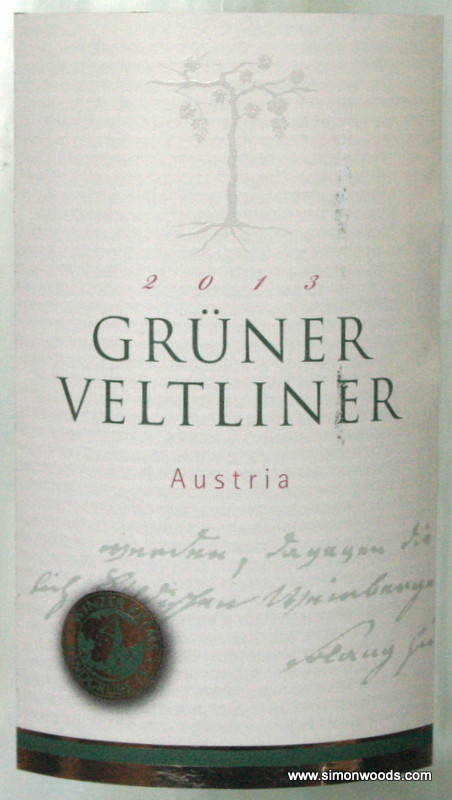
Gruner Veltliner spreads around the world

Posted by Simon on July 16, 2010

Newsflash! OK, not a newsflash in the strict sense of the word. On this occasion, it’s the name given to the newsletter from Laurenz Maria Moser V, a man whose family founded the famous Lenz Moser wine company in Austria, and who now, with his Laurenz V range, seems to have taken it upon himself to spread the Gruner gospel around the world.

The July issue of Newsflash has just appeared, and I’d normally have linked to it on the Laurenz V web page, but for some reason it only goes up to June at the moment.

Anyway, the bit in it that caught my eye was about plantings of Gruner Veltliner. Austria still dominates, with 17,151 hectares. However… ‘Laurenz Maria drank Gruner grown in Pennsylvania lately (pas mal ;-), the biggest other countries are Hungary (2 ha), Czech Republic (1 ha), Slovenia (1 ha), Australia (50 ha), New Zealand (yes, 20 ha), and a bit in Argentina (2 ha), China and some in the USA (Napa Valley) – THE IDEA SEEMS TO SPREAD!’

I’m a big fan of Gruner from Austria, and it’ll be interesting to see whether other countries can capture the minerally purity of the top Austrian wines. I think Lark Hill in Canberra produced the first Aussie version in 2009. Look out too in the near future for New Zealand Gruner, courtesy of winemaking supremo Matt Thomson.

Two-tiered DACs – what are they, and should we give a stuff?

Posted by Simon on March 3, 2010

Just had an eager press release – text is below, more (in German) on the website here – about how the Austrians have brought in a new category of wine, Weinviertel DAC Reserve. The announcement that a region that hardly anyone has heard of now has both normal and reserve levels of DAC (equivalent to France’s AOC) is obviously ‘a big deal’ for those in Vienna, but I wonder just how relevant it is to those outside the country.

Since the so-called anti-freeze shenanigans of the 1980s, Austria has been almost OCD in its concern that nothing shall tarnish the image of its wines. The result has been a surge in quality, and a growing band of enthusiasts around the world. If the idea of DAC is to impress outsiders, we’re actually sufficiently impressed already without any more regulations.

I for one won’t be rushing to recommend my readers to seek out the term DAC on wine bottles. In a recent issue of Decanter, Giles MacDonogh compared Grüner Veltliner’s performance in Austria with that of Pinot Noir in Burgundy. At the heart of the piece were two assertions: firstly that Grüner Veltliner has an innate ability to transmit the characteristics of the various Austrian terroirs. But secondly, as he said in conclusion, ‘…soil alone is not enough: the best wines still come from the best winemakers.’

In other words, the most important thing to remember for those in search of the top wines of Austria is not a list of DACs, but the names of the finest producers.

Anyway, the press release…

With the Weinviertel DAC Reserve, the Weinviertel joins the rest of Austria’s two-tiered DACs.
In 2003, the Weinviertel became the first Austrian wine-growing area to market typical wines of origin under the specific name of the region. This gave the Weinviertel DAC its pioneering role for wines with a clear identity and a typical taste profile. So far, six other regions – Mittelburgenland, Traisental, Kremstal, Kamptal, Leithaberg and Eisenberg – have joined this appellation system as well. And now with the 2009 vintage, the available two-tiered DAC system, which includes the Reserve level, has been introduced also in the Weinviertel. With this, the taste profile should reflect even more typicity. And the number of wines that come on the market under the Weinviertel designation should increase.

Weinviertel DAC Reserve – additional taste profiling
Since the introduction of the Weinviertel DAC with the 2002 vintage, six other regions joined the DAC appellation system (Mittelburgenland, Traisental, Kremstal, Kamptal, Leithaberg and Eisenberg). And when those six regions joined, they included and brought to the market the Reserve category as well (except the Leithaberg, which carries the Reserve category only). A Reserve wine is the top wine: it is the winery’s highest quality; its centerpiece. That is why the criteria for a region-typical top wine are strictly applied – the high quality of the wines is guaranteed.

After several years of discussions, the Regional Wine Committee Weinviertel decided at the beginning of last September to introduce a Weinviertel DAC Reserve with the 2009 vintage. “With this, the Weinviertel wants to provide the top wines of the region with the successful Weinviertel designation of origin, giving them even higher importance and value,” explains Roman Pfaffl, head of the Wine Committee Weinviertel. “These wines symbolize the power and strength of the Weinviertel.”

The concept was presented to the National Committee for assessment and, after being affirmed, was delivered to Austria’s Federal Ministry of Agriculture, Forestry, Environment and Water Management, where it was signed into law by Federal Minister Niki Berlakovich in February.

Criteria for the Weinviertel DAC Reserve
As with the Weinviertel DAC wine, the Weinviertel DAC Reserve – level wine must demonstrate a clear, region-typical taste profile – it must be a peppery Grüner Veltliner from the Weinviertel. But it also must have other distinguishing features: dry; a dense structure; a long finish and a robust style. Subtle Botrytis and wood tones are acceptable.

The minimum alcohol content – at least 13 % vol. – must be printed on the label. Filing for a government approval number can be done no earlier than March 15th of the year following the harvest.

The purchasing of additional grapes for the production of Weinviertel DAC Reserve wines is permitted only within the region. “Trauben für Weinviertel DAC Reserve“ (grapes for Weinviertel DAC Reserve) must be stated on the invoice, and the natural must weight in KMW (Klosterneuburger Mostwaage) must be declared as well.

Regarding the application for a government approval number four out of six tasters must agree that the wine, from a sensory perspective, can be marketed under the name Weinviertel DAC Reserve.

Before the first-time application for a government approval number, written notification must be given to the Regional Wine Committee Weinviertel.

Bottling is to take place in the production enterprise (winery) and in the Weinviertel. If bottling is to take place outside of the region, then it must be approved first by the Regional Wine Committee.

Wine with the Weinviertel DAC Reserve designation can be sold only when the bottle features a specific capsule. This is a uniform capsule for the Weinviertel DAC and Weinviertel DAC Reserve wines, and can be obtained only with the approval of the Wine Committee Weinviertel. Moreover, a per-capsule fee must be paid to, and utilised by, the Wine Committee Weinviertel.

Beginning with the 2012 vintage, each winery producing a Weinviertel DAC Reserve must be certified according to a regional quality management system developed by the Weinviertel Regional Wine Committee and implemented and monitored by an external auditor.

Grüner Veltliner, Sicilian Muscat, Cape Chenin and a tasty Friulian white

Posted by Simon on January 15, 2010

Really enjoyed this quartet of very different whites

Felsner Moosburgerin Grüner Veltliner 2008, Kremstal, Austria (£9.49 Waitrose)
Clean, tangy peppery style, nice mix of lime and grapefruit tang with an earthier weightier core, also some pebbly/minerally character, fresh vibrant finish. S(-)

Duca di Castelmonte Gibele Zibibbo Secco 2008, Sicily, Italy (£11.49 Hallgarten Druitt, www.wineman.co.uk, www.everywine.co.uk, Winos)
Fleshy grape and orange flavours tinged with rose petal and jasmine, quite full bodied, with an almost oily walnut edge. Perhaps too big for an aperitif, but good with fuller fish dishes. S-

The Society’s Exhibition Chenin Blanc 2008, Piekenierskloof, South Africa (£9.50 The Wine Society)
Cooked apple and honey, quite powerful, rich but bracing, thanks to zesty acidity, very tasty now, but will become even more honeyed with another couple of years in bottle. S(-)

La Tunella La Linda Colli Orientali di Friuli 2008, Italy (N/A in UK)
Richness and peachy flesh backed up by some creamy/bready lees character and a clay-like minerality, touch of pomegranate, and an edge of spice, one of those wines that creeps up on you. S-

Good cork, bad cork, bye-bye hamster

Posted by Simon on August 12, 2009

Brundlmayer

Mixed emotions chez Woods this evening. At approximately 6pm, our hamster Smudge trotted off to the great trundle wheel in the sky. She seems to have gone out on a high after having had an energetic work out in her plastic orb in the company of five rather rowdy children. Apparently, once back into her cage, she wended her way through a maze of tubes and then just went limp. A doctor arrived half an hour later, but he was the parent of three of the children, and wasn’t so much interested in the well-being of a two-year-old rodent as in having a Coopers Pale Ale – another case of the NHS not being what it was during the Blitz…

After the Pale Ale was all gone, the good doctor (I don’t know if he’s good as he works in a different borough from where we live, but I can imagine he has a decent bedside manner), his wife and the two of us worked our way through a bottle of Bründlmayer Grüner Veltliner Alte Reben 1999 from Kamptal in Austria. At 10 years old, it was fighting fit, and although I don’t know how alte (old) the reben (vines) were in this instance, certainly there was some power and persistence to the fragrant pepper, pear and citrus flavours. Add in notes of minerals, some waxy, honeyed maturity and that peculiar earthy lentil character of older Grüners, and you had a wine that was just singing.

And certainly one that was holding up better than the 1998 Polish Hill River Vineyard Riesling I opened last night with some friends. It came from what used to be the Mildara Blass stable, and was made by David O’Leary, who’s now making some cracking Riesling under the O’Leary Walker label. And I have a feeling that this too would have been a cracking wine were it to have had either a screwcap or a better cork. As it was, it came across like a fading Alsace wine, ripe and rich, but with an odd dried burnt sugar edge (I know what I mean by that, not sure if others will) and its fruit fading into obscurity. It tasted far, far older than the excellent Mount Horrocks 2000 Riesling that I drank over the weekend (see here), but then that was one of the first batch of Clare Valley wines with the Stelvin closure.

St Bris

And when the Grüner had all gone, we moved on to the 2007 St Bris from Clotilde Davenne (£7.95 www.fromvineyardsdirect.com). Yes, we should have done them the other way round, but hey, after a sip or two we weren’t complaining. St Bris is one of those wines that’s not sure whether it wants to be Sancerre or Chablis. At its best – here – it combines the grassy pungency of a Loire Sauvignon with the creamy minerality of Chablis, and at a price that undercuts both. Very tasty wine, perfect for mourning the death of a hamster…

Federer-friendly whites

Posted by Simon on July 5, 2009

Anyone else have to delay their evening meal because of this afternoon’s tennis? And while we’re on the tennis – and I’m not trying to take anything away from the achievements of Roger the Dodger – did anyone get to a stage in that final set where they just wanted the whole thing to finish? OK, I did have some potatoes in the oven, but they were swimming happily in duck and wine juices and didn’t object to the extra cooking time, but non-tennis loving heretic that I am, I have to confess that after it got to 8-8, I did get a bit bored. No matter, the potatoes and the duck (legs – poached then grizzled up under the grill) were interesting, as were the accompanying wines.

First up was Joachim Flick’s Wickerer Mönchsgewann Riesling Erstes Gewächs 2003 from the Rheingau in Germany. And despite 03 being a warm vintage in the region (not to mention elsewhere in Europe), this had pithy citrus acidity to back up the voluptuous, peachy, tropical fruit and mineral flavours, and reminded me of top-notch Alsace Riesling. You might find some of Flick’s wines at The Winery in Maida Vale, but they’ve probably run out of this gem.

Equally duck-friendly was the 2006 Stift Göttweig Grüner Veltliner Gottschelle from Krems in Austria. This comes from an estate founded in 1083 which received a new lease of life recently when its vineyards were leased to a group headed by Fritz Miesbauer of Weingut Stadt Krems. In the couple of years since I last tasted it, the plum and peach flavours have fleshed out, but there’s still a savoury, mineral tang, the classic peppery overtone, and the potential to develop further in bottle. O W Loeb are the UK agents (and if you get the last glass from the bottle, beware – it’s already throwing lots of tartrates)

I’m not sure what Roger would have been supping this evening, but he’d have struggled to match these two intriguing and tasty whites.

A la recherche du vin perdu

Posted by Simon on February 15, 2009

Not that I’ve lost a wine, but am I alone in finding that despite having a decent raft of bottles to plunder, sometimes it’s difficult to find just what’s required? Something rather basic for tonight’s meal, a swanky restaurant might dub it mini schnitzel or escalopes, but basically it’s upmarket, chicken nuggets, albeit home-made ones with a coating of breadcrumbs seasoned with garlic, onion, ground coriander and black pepper. Cooked in a hot oven rather than with recourse to the frying pan, it’s one of those dishes that is as appealing to a seven-year-old as it it to someone whose 7th birthday was close to the arrival of decimal currency.

First port of call was a bottle of Anakena Ona 2006, a blend of Cabernet Sauvignon, Merlot and Carmenere. Good wine but a little too assertive for what I wanted to drink. Next came the Errazuriz La Cumbre Shiraz. I’ve got to write something in the next week or so about Chilean Shiraz, and this bottle had been whispering, ‘Drink Me…’ for a number of weeks. Should have ignored the whines. It’s a big beast, and one that has bags more life ahead of it. Will revisit it (and the Ona) over the next few days, and expect it to improve.

Keeping with the Syrah themes, I thought I’d try Yves Cuilleron’s Vin de Pays Syrah 2005 – apprentice Cote Rotie, if you like. Tasty, tasty wine, but one that I should have pulled out of the cellar (at its coldest at this time of year) half a day earlier.

Getting desperate by this point, and with the dinner nearly ready, I dove into white territory and found the Dr Unger 2005 Gruner Veltliner Gottschelle Reserve from Kremstal in Austria. Eureka! Tangerines (extreme tangerine), grapefruit, rich tangy and mineral, perfect for the slightly fatty decadence of the super-nuggets, and, at 13% alcohol, more restrained than some of the Unger wines, it was the vin perdu that I’d been looking for.

I’ve no doubt that all three reds will be better tomorrow, but I’m going to spend this evening with the good Doctor…